
Sorry, but your login has failed. Please recheck your login information and resubmit. If your subscription has expired, renew here.
Purchase orders (POs) are one of the most routine activities in procurement. Yet APQC benchmarking data shows that organizations spend anywhere from $14 to more than $54 to process a single purchase order, a nearly fourfold difference for the same transaction. For companies issuing tens or hundreds of thousands of POs each year, that gap can translate into millions of dollars in operating cost.
Research indicates that these differences are largely driven by how procurement work is structured and executed. Variations in process design, operating models, and purchasing discipline lead to meaningful differences in cost, productivity, and speed. Understanding where these gaps emerge provides a clear view into what top-performing procurement teams do differently to reduce costs.
SC
MR
Sorry, but your login has failed. Please recheck your login information and resubmit. If your subscription has expired, renew here.
Purchase orders (POs) are one of the most routine activities in procurement. Yet APQC benchmarking data shows that organizations spend anywhere from $14 to more than $54 to process a single purchase order, a nearly fourfold difference for the same transaction. For companies issuing tens or hundreds of thousands of POs each year, that gap can translate into millions of dollars in operating cost.
Research indicates that these differences are largely driven by how procurement work is structured and executed. Variations in process design, operating models, and purchasing discipline lead to meaningful differences in cost, productivity, and speed. Understanding where these gaps emerge provides a clear view into what top-performing procurement teams do differently to reduce costs.
Cost per purchase order varies widely
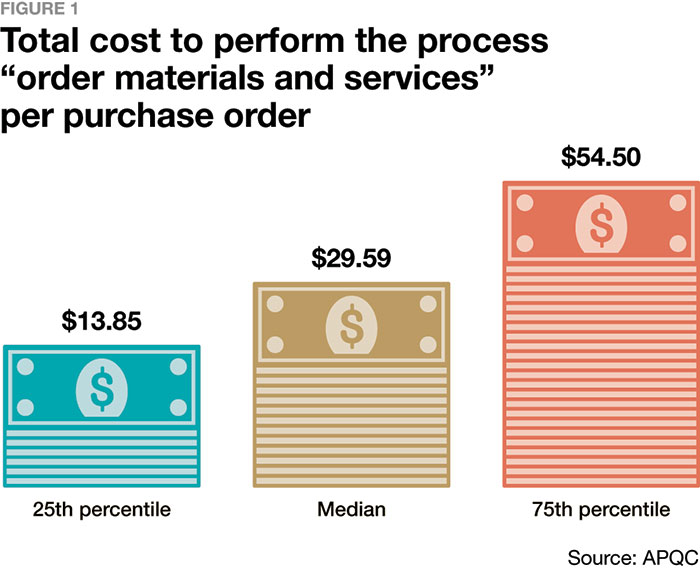
APQC finds that organizations spend an average of $42 to process a purchase order, but the more important story is the wide variation across organizations. Most organizations (90%) spend less than $100 per PO, but there is wide variability among organizations within this range. Organizations at the lower end of the benchmark range (the 25th percentile) spend around $14 to process a purchase order, while those at the 75th percentile spend nearly four times as much ($54.50) to process the same transaction (Figure 1).
Industry differences can also play a role. For example, healthcare organizations tend to have higher purchase order costs due to additional compliance and documentation requirements compared with industries such as consumer products. However, even within industries, variation in performance remains significant. Benchmarking within your specific industry can provide a more accurate view of relative performance.
See related infographic: The $4 million procurement gap
While industry factors contribute to cost differences, APQC research shows that procurement costs are largely driven by labor and process complexity. As a result, differences in cost per purchase order often reflect variation in the following.
- Process design
- Governance
- Automation maturity
- Purchasing compliance
Two related metrics—purchase orders processed per employee and cycle time to issue a purchase order—help explain how these differences translate into performance gaps.
Productivity and speed drive the performance gap
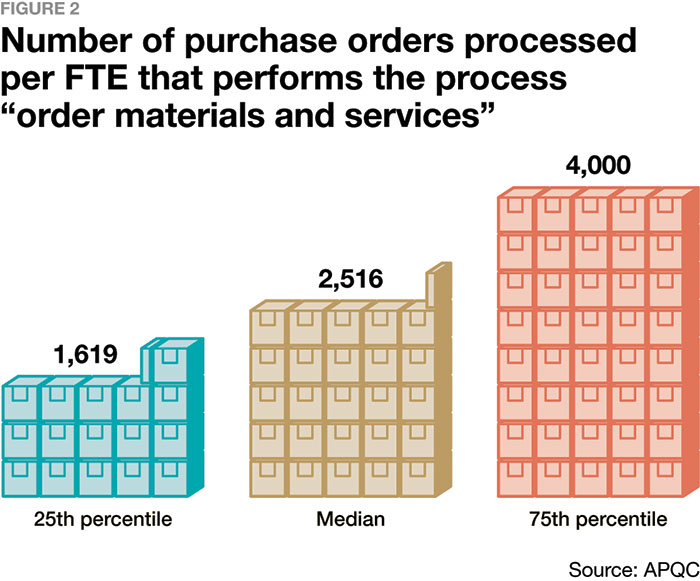
Top performers process more than twice as many purchase orders per employee. The number of purchase orders processed per procurement full-time equivalent employee (FTE) provides a useful measure of staffing productivity. APQC finds that top-performing procurement teams process more than twice as many purchase orders per employee as lower-performing peers (Figure 2).
These differences are often driven by the level of manual intervention in the process. Organizations with more manual workflows may experience delays as teams chase approvals or correct data entry errors. Even small inefficiencies, when multiplied across thousands of transactions, can result in significant productivity losses.
Top performers issue purchase orders in less than half the time. Cycle time to issue a purchase order provides another perspective on procurement efficiency and maturity. APQC benchmarking shows that top-performing organizations can issue a purchase order in about one day, while lower-performing organizations take more than twice as long (Figure 3).

Shorter cycle times typically reflect streamlined workflows, standardized purchasing procedures, and fewer manual interventions. Longer cycle times often point to fragmented processes, approval bottlenecks, or inconsistent purchasing channels.
A lack of standardization in purchasing is a common contributor to longer cycle times. When employees use inconsistent channels or submit off-contract requests, they create additional manual work and reduce visibility into spend. These exceptions add time to the process and increase overall transaction costs.
What top performing procurement organizations do differently
These performance gaps reflect differences in how procurement is structured, how work is carried out, and how consistently processes are followed. APQC research finds that the three practices below consistently separate top-performing procurement organizations from their peers.
Centralize direct procurement. One of the clearest differences between top-performing organizations and their peers is that top performers centralize procurement. Centralization brings procurement under a single operating model, allowing organizations to coordinate demand, reduce duplicate efforts across business units, and manage supplier relationships at an enterprise level. This broader visibility and alignment enable procurement teams to leverage preferred vendors, streamline sourcing decisions, and process higher volumes of purchase orders without adding headcount.
Organizations that centralize direct procurement tend to have lower costs, faster cycle times, and higher productivity. Centralization brings procurement under a unified operating model, enabling organizations to coordinate demand, reduce duplicate efforts across business units, and manage supplier relationships at an enterprise level more effectively. This broader visibility and alignment enable procurement teams to leverage preferred vendors, streamline sourcing decisions, and process higher volumes of purchase orders without increasing headcount.
Standardize procurement processes. Centralization creates an opportunity to standardize how purchase orders move through the process. Top-performing organizations define consistent purchasing workflows so transactions follow a predictable path. This consistency reduces variation that can slow processing and, just as importantly, creates a foundation for automation, AI, and other core improvement tools. With standardized processes, organizations can rely more on systems to route and validate purchase orders, reducing manual effort and shortening cycle times.
Strengthen purchasing governance. Even well-designed, standardized processes break down when employees operate outside of them. Purchases are made through unapproved channels or with non-preferred vendors introduce exceptions that require additional validation and manual intervention. Organizations with stronger purchasing governance reduce these exceptions, helping maintain consistent workflows, improve visibility into spend, and lower transaction costs.
The cost of inefficiency adds up quickly
The impact of these practices becomes clear at scale. For an organization issuing 100,000 purchase orders annually, the difference between top-performing and higher-cost procurement functions can exceed $4 million in transaction costs alone. Top performers spend approximately $1.38 million to process these transactions, compared to $5.45 million for higher-cost organizations.
Implications for procurement leaders. While many procurement leaders focus improvement efforts on strategic sourcing and supplier negotiations, the procurement process itself is a significant and actionable source of cost savings. Improving transaction efficiency not only reduces operating costs but also frees up procurement capacity to focus on higher-value activities like supplier collaboration, risk management, and innovation.
Where procurement leaders should focus. To take advantage of these opportunities, procurement leaders should focus on these four priorities:
- Benchmark transaction efficiency. Measure the cost per purchase order and productivity per procurement employee and compare your results with relevant benchmarks.
- Centralize direct procurement. Reduce unnecessary fragmentation and duplication to improve visibility, streamline processes, and lower transaction costs.
- Standardize procurement processes. Establish consistent purchasing workflows and approval procedures across the enterprise to reduce variation and improve efficiency.
- Strengthen purchasing governance. Reduce maverick buying by enforcing approved procurement channels and supplier lists.
Data in this content was accurate at the time of publication. For the most current data, visit apqc.org.
About APQC
APQC (American Productivity & Quality Center) is the world’s foremost authority in benchmarking, best practices, process and performance improvement, and knowledge management (KM). With more than 1,000 member organizations worldwide, APQC provides the information, data, and insights organizations need to support decision-making and develop internal skills. Learn more at apqc.org.
This content includes median values sourced from APQC’s Open Standards Benchmarking database. If you’re interested in having access to the 25th and 75th percentiles or additional metrics, including various peer group cuts, they are either available through a benchmark license or the Benchmarks on Demand tool depending on your organization’s membership type.
APQC’s Resource Library content leverages data from multiple sources. The Open Standards Benchmark repository is updated on a nightly cadence, whereas other data sources have differing schedules. To provide as much transparency as possible, APQC will always attempt to provide context for the data included in our content and leverage the most up-to-date data available at the time of publication.
SC
MR


More Procurement Trends
- Procurement’s moment has arrived
- How efficient is your procurement process?
- Unlocking better negotiation outcomes: How after-action reflections can transform supply chain performance
- Agentic AI is turning long-tail purchase orders into true cost savings
- The $4 million procurement gap
- More Procurement Trends
 Explore
Topics
Procurement & Sourcing News
- Why companies blame the wrong supplier … and miss the real failure
- NextGen Supply Chain Conference unveils agenda focused on AI, execution and the future of leadership
- From fragmented negotiations to coordinated negotiation performance: an AI-enabled approach
- Supply chain resilience isn’t a data problem; it’s a judgment problem
- Why your supply chain risk management plan will fail
- When component verification becomes operational
- More Procurement & Sourcing
Latest Procurement & Sourcing Resources
About the Author
Marisa Brown, Senior Principal Research Lead

Marisa Brown is senior principal research lead, supply chain management, APQC.
Follow SCMR on social media.
@SupplyChainManagementReview on Facebook
@SCMR on Twitter
SCMR on Linkedin
Subscribe

Supply Chain Management Review delivers the best industry content.

Editors’ Picks



